Brazen Kentucky Thieves Didn’t Even Wait For Corvettes To Leave The Factory Before Stealing Them

Eight stolen Chevrolet Corvettes were recovered this week, according to Bowling Green Police. A somewhat disorganized auto theft...

At $13,000, Will This 1980 Porsche 924 Turbo Get Its Due?

While unfairly considered the red-headed stepchild of Porsche's sports car line, today's Nice Price or No Dice 924...

2025 Chevrolet Blazer EV SS Is A Normal Family Crossover With Supercar Speed

It took a hell of a long time for Chevy to get the 2025 Blazer EV SS out...

2026 Chevrolet Corvette’s Redesigned Interior Is Way More User-Friendly But Thankfully Still Strange

When the eighth-generation Chevrolet Corvette debuted in 2019 it was controversial in a lot of ways. Its styling...

Just How American Actually Is A Tesla? Here’s Where The Key Components Come From

Over the last 15 years, Tesla has been a shot in the arm for the American automotive industry,...

Cars Are About To Get A Whole Heap More Expensive

Good morning! It's Thursday, April 3, 2025, and this is The Morning Shift: Your daily roundup of the...

This $1,500 Homebuilt Volkswagen Beetle Hot Rod Says You Don’t Have To Be Rich To Go Fast

In the current automotive marketplace speed is a very expensive commodity. The average 0-to-60 time of the vehicle...

Honda Packs Electric Prologue With More Range And Power For The Same Price In Effort To Conquer Tesla

Honda says that its Ultium-based Prologue was the second-best selling electric SUV in America in the final quarter of...

Volkswagen Put An Experimental W10 Engine In BMW’s Best M5

The legend of the Volkswagen Group's rebellious, daring, and absurdist creations pitched and produced under the rule of...

Ford, Bring Back The Flex As An EV, Please, We’re Begging You

The Ford Flex didn't necessarily need to exist, and yet, the odd crossover/wagon/minivan stuck around for a full...

You Need A 700-Horsepower Subaru WRX STI In Your Life

So you want a fast car, but you're not looking to drop supercar cash on something so mechanically...

2025 Toyota GR Corolla Might Be The Coolest Way To Zoom Through Winter

Easy on the throttle, brake, early apex, flick left then turn right, wait for the front end to...

This Yankee Never Won The World Series, But It Finished Second In Class At Le Mans

How quickly do you think a 2002 Porsche 911 GT3 R Le Mans GT2-classed race car could round...

In Rare Bit Of Good News, Used Cybertruck Values Keep Trending Down

Even if you could somehow set aside Elon Musk's controversial role in DOGE, the Tesla Cybertruck sucks. It's bad...

Subaru Hid Six Darling Easter Eggs In The Redesigned 2026 Outback

As an outspoken warrior of whimsy, I'm a fervent proponent of doing things exclusively to elicit a smile....

BMW Celebrates GT3 Driver Valentino Rossi’s Birthday With A Special Edition M4 CS

Valentino Rossi is a MotoGP legend. A nine-time world champion, he's the only motorcycle racer to have completed...

Looming Tariffs Caused An April ‘Bank Run’ On Car Dealers

Free IVF, DOGE checks, and a lot of the other stuff Trump said he'd deliver if elected may...

Trump To Scale Back Auto Tariffs

Good morning! It's Tuesday, April 29, 2025, and this is The Morning Shift, your daily roundup of the...

The Philosophy of Automotive Brand Design: How Visual Identity Shapes Brand Perception

The relationship between automotive design and human perception represents one of the most complex and fascinating intersections of...

2026 Toyota C-HR Returns As An EV With Attractive Styling And More Power Than The GR Corolla

Toyota debuted the 2026 bZ crossover yesterday, a facelift for what used to be called the bZ4X that should...

Ford’s Twin I-Beam Front Suspension Was A Simple But Genius Design
For the first few decades of the 20th century, pickup trucks were pretty primitive machines. Spartan cabs with little in the way of creature comforts, simple, torquey drivetrains, and solid axle front suspensions were the name of the game. After World War II, however, trucks started to get small luxuries like headliners, synchronized transmissions, and chrome trim as hand-me-downs from their more civilized coupe, sedan, and wagon cousins. Their underpinnings remained positively agricultural, however, until General Motors revolutionized truck suspension with the all-new front double wishbone setup for half-ton pickups.

See, up until then, the state of the art in pickup truck front suspension was the tried and true solid axle. It was basically a small I-beam with a wheel on each end suspended by, depending on the manufacturer and era, some combination of leaf springs, torsion rods, and shock absorbers. GM’s double wishbone setup used a pair of wishbone shaped assemblies sprung by individual coil springs to isolate the front wheels from one another. This was far from a new technology, but it was new to trucks.

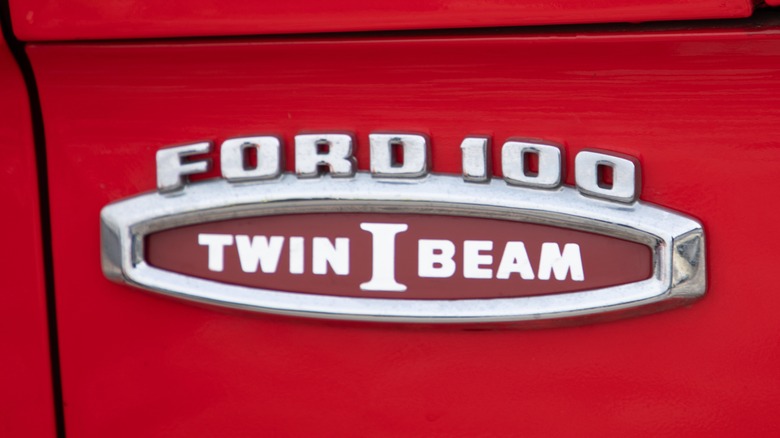
Meanwhile, in Dearborn, the big brains at the Ford Motor Company were busy at work on their own independent suspension design. Ford engineers started tinkering with an IFS for the company’s F-series trucks in 1959, and GM’s introduction of its double wishbone setup kicked the boys at Ford into overdrive. Finally, in 1965, Ford announced the twin I-beam front suspension — a technology that the company would use for the next five decades.

How does it work?

Ford’s twin I-beam design was as simple as it was brilliant. Basically, it consisted of two short, heavy duty, I-beam axles made of forged chromoly. The beams were offset and overlapping, hung from either side of a transverse frame rail under the truck’s front end. The attachment points were pivots, and they were connected at the opposite side of the truck from the wheel they carried — the right wheel pivot was on the left side of the truck and vice-versa. Each axle had a coil spring, a shock absorber, and a heavy steel radius arm to keep it from moving fore and aft. This suspension setup was a huge step up in handling and ride quality for Ford, and soon it was slapped on everything from the F-100 to the F-350.

While it was largely a revelation, the twin I-beam setup did have its drawbacks. Since it worked like an old-time swing axle, the front wheels’ camber changed whenever the axle moved up and down. This wasn’t as marked as the camber change on, say, a Corvair or Volkswagen Beetle, but it was still there and led to uneven tire wear and slightly unpredictable handling on paved roads. In addition, it can be tricky to align the wheels on a twin I-beam setup, especially as the suspension parts wear.

Aside from those issues, the twin I-beam suspension setup was a big success for Ford. The company kept improving on the design over the years — replacing the old-school kingpin steering knuckles with modern ball joints, for example, and introducing a 4WD version in 1980 called the Twin Traction Beam — but eventually Ford replaced the twin I-beam on the F-150 with the lighter, more modern A-arm suspension.


Source: http://www.jalopnik.com/1842219/ford-twin-i-beam-front-suspension-design/

Inline Feedbacks
View all comments
guest